Rather than start a new blog, as was my intention, I've decided to dust down and resuscitate an old one that I think will serve my purposes well. It's got the added advantage of containing lots of things I've blogged about in the past, in various places, gathered together as a kind of archive. However, rather than dwell on past blog posts too much, this is a new beginning for me, and a way to communicate to an audience and work through some of my thoughts and ideas about my writing and research. It's also a place for me to continue to develop my evolving sense of who I am as a writer and critic, so while I have blogged about comics primarily, I'm planning to dive into the other areas I'm interested in too, including literature, film, TV and music.
I was recently moved by something Mark Rylance said on the South Bank Show. I can't profess to be a fan of his acting, only because I haven't seen anything he's been in (an omission I'll definitely be rectifying soon). He was talking about the single most important piece of advice for new actors, and he distilled it into three words - "You are enough". He says that the fear and self-doubt that actors feel is borne of the worry that they will not measure up, when in fact the opposite is true -- it's often enough that the actor is on stage and performing, while an audience is willing them on the give a good performance.
I think this applies to all manner of artistic processes and life in general, whether it's writing or being the best person we can be generally. Perhaps we should all try to banish self-doubt as best we can and simply aim to be "enough". I think this blog is my attempt to live by this philosophy a little more by turning up here to write, think and communicate more.
Friday, July 17, 2015

Monday, May 11, 2015
Alan Moore and H P Lovecraft
I'm really looking forward to Alan Moore's new series Providence, inspired by H.P. Lovercraft's life and work. Here is a really interesting interview with Moore about the series.

Wednesday, June 19, 2013
Conference - Academic Study Skills
I am very proud of this conference held at Glyndwr University on Monday. Here is a write up of it. I missed being in the picture because I went for food - me and my appetite ;-) It was months in the planning and an incredibly satisfying experience :-)
Friday, March 15, 2013
Sequart and Swamp Thing
Here's my author page on Sequart, including the work in progress on my Swamp Thing book and my other columns. Go on - give it a visit!
Tuesday, March 5, 2013
Blast from the past: part 5
My final ICS post, originally uploaded on 7th Nov, 2009 here.
THE THRILL OF THE NEW.
THE THRILL OF THE NEW.
Andrew Edwards here.
My experience with Manga is limited. Until recently, I think I held quite a negative view of it, and subscribed to the view that is was limited in terms of art style (impossibly wide eyed characters) and subject matter (immature cutesy-ness or overly violence). Yet this assumption was subconscious, one I’d barely formulated – and I’d never really read any Manga (except for a translation of Barefoot Gen some 15 years ago, which I’d enjoyed but hadn’t revisted, and had largely forgotten about).
And then I read Ode to Kirihito by Osamu Tezuka, the father of Manga, thanks to a copy loaned to me by Dan Berry (thanks again Dan!), senior lecturer on the BA Illustration for Graphic Novels at Glyndwr University, Wrexham (see links below). I read this huge tome and I was blown away. It was amazing stuff. It’s the story of a doctor fighting a disease which deforms people’s appearance, leading them to look distinctly dog-like. Like all good art it challenged my preconceptions and I wanted to know more. So I’ve spent some time reading Paul Gravett’s Manga – Sixty Years of Manga this week. Like all of Mr Gravett’s book it’s a very accessible guide, both clearly written with wonderful illustrations.
You have to admire the influence of Manga in Japan, if only for the fact that it accounts for around 40% of all print publications, which is astonishing. Gravett’s book has allowed me to become acquainted with, and then immersed in, a whole new comics culture, something I haven’t really had the pleasure of since I first discovered UK comics (aged 5) and American comics (aged 11 or 12). It’s taught me to read more widely in the medium. Now I just need to make a start on the Franco-Belgian stuff…
You can find Dan’s excellent site ‘The Comics Bureau’ here and details of the BA degree here.
My experience with Manga is limited. Until recently, I think I held quite a negative view of it, and subscribed to the view that is was limited in terms of art style (impossibly wide eyed characters) and subject matter (immature cutesy-ness or overly violence). Yet this assumption was subconscious, one I’d barely formulated – and I’d never really read any Manga (except for a translation of Barefoot Gen some 15 years ago, which I’d enjoyed but hadn’t revisted, and had largely forgotten about).
And then I read Ode to Kirihito by Osamu Tezuka, the father of Manga, thanks to a copy loaned to me by Dan Berry (thanks again Dan!), senior lecturer on the BA Illustration for Graphic Novels at Glyndwr University, Wrexham (see links below). I read this huge tome and I was blown away. It was amazing stuff. It’s the story of a doctor fighting a disease which deforms people’s appearance, leading them to look distinctly dog-like. Like all good art it challenged my preconceptions and I wanted to know more. So I’ve spent some time reading Paul Gravett’s Manga – Sixty Years of Manga this week. Like all of Mr Gravett’s book it’s a very accessible guide, both clearly written with wonderful illustrations.
You have to admire the influence of Manga in Japan, if only for the fact that it accounts for around 40% of all print publications, which is astonishing. Gravett’s book has allowed me to become acquainted with, and then immersed in, a whole new comics culture, something I haven’t really had the pleasure of since I first discovered UK comics (aged 5) and American comics (aged 11 or 12). It’s taught me to read more widely in the medium. Now I just need to make a start on the Franco-Belgian stuff…
You can find Dan’s excellent site ‘The Comics Bureau’ here and details of the BA degree here.
Blast from the past: part 4
Here's the penultimate ICS post, originally uploaded here on October 31st, 2009.
ENDLESS POSSIBILITIES.
ENDLESS POSSIBILITIES.
Andrew Edwards here.
In my ongoing study of comics I’ve come across many attempts to define comics and explain how they work. These include Will Eisner’s Comics and Sequential Art and Scott McCloud’s Understanding Comics, both being popular, accessible and wonderful works, in my opinion. There are also the more academic works which are of great interest too, such as Thierry Groensteen’s The System of Comics, which is a challenging but ultimately rewarding read thus far (I’m working my way through it at the moment).
However, my favourite definition and explanation is just one sentence long, and it’s perfect. Here it is:
“They’re words and pictures, and you can do anything with words and pictures.”
These are the words of Harvey Pekar, creator of the groundbreakingAmerican Splendor series. Like most of the definitions of the form we can find, it can’t quite capture all forms of comics (such as mute ones), but it’s still close to perfect in it’s simplicity and adaptability.
I’ve been thinking about the function of comics, and Pekar’s belief that they can do “anything”. I think that there is a growing awareness of the potential of the comics medium to move beyond entertainment (as great as that is). In particular, I think that the potential for comics as a medium for instruction and learning is vast, and it’s an area I’m currently researching, and I’m finding it fascinating, being someone with a working background based in education and libraries.
One significant example is the work of Will Eisner. While his Spirit work and Sequential Art instruction texts are well known, his two decades plus work using comics as an educational tool are relatively unexplored. A great resource that contains lots of examples of his work can be found online via VCU libraries Digital Libraries– check it out to see another example of what comics are capable of. It’s a totally free and accessible resource, and well worth checking out. You can find it here.
I think that the future of comics lies in its acceptance by mainstream society and culture and the continued diversification of the functions of comics can only help to sustain the growth of the medium. I can’t wait to see what other areas will be enriched by using comics in the future!
In my ongoing study of comics I’ve come across many attempts to define comics and explain how they work. These include Will Eisner’s Comics and Sequential Art and Scott McCloud’s Understanding Comics, both being popular, accessible and wonderful works, in my opinion. There are also the more academic works which are of great interest too, such as Thierry Groensteen’s The System of Comics, which is a challenging but ultimately rewarding read thus far (I’m working my way through it at the moment).
However, my favourite definition and explanation is just one sentence long, and it’s perfect. Here it is:
“They’re words and pictures, and you can do anything with words and pictures.”
These are the words of Harvey Pekar, creator of the groundbreakingAmerican Splendor series. Like most of the definitions of the form we can find, it can’t quite capture all forms of comics (such as mute ones), but it’s still close to perfect in it’s simplicity and adaptability.
I’ve been thinking about the function of comics, and Pekar’s belief that they can do “anything”. I think that there is a growing awareness of the potential of the comics medium to move beyond entertainment (as great as that is). In particular, I think that the potential for comics as a medium for instruction and learning is vast, and it’s an area I’m currently researching, and I’m finding it fascinating, being someone with a working background based in education and libraries.
One significant example is the work of Will Eisner. While his Spirit work and Sequential Art instruction texts are well known, his two decades plus work using comics as an educational tool are relatively unexplored. A great resource that contains lots of examples of his work can be found online via VCU libraries Digital Libraries– check it out to see another example of what comics are capable of. It’s a totally free and accessible resource, and well worth checking out. You can find it here.
I think that the future of comics lies in its acceptance by mainstream society and culture and the continued diversification of the functions of comics can only help to sustain the growth of the medium. I can’t wait to see what other areas will be enriched by using comics in the future!
Blast from the past: part 3
From my old ICS days: this was originally posted on Oct 24th, 2009 here.
Conferences and Journals.
Andrew Edwards here.
I’ve been thinking about conferences and journals recently, and the important role that they play in promoting and advancing the study of comics.
On 21st November I’ll be attending the Thought Bubble festival in Leeds, specifically the Possibilities and Perspectives Conference. I’m there as ICS Assistant Director for Great Britain. I’ll be talking about ICS and my own scholarship and criticism in the morning, and chairing a panel in the afternoon.
One of the great things about events like this is that they spread Comics Studies into fandom and this raises the awareness of the range of possibilities open to potential scholars. It’s a fine mix of academics, professionals, critics and enthusiasts that will be involved and it really highlights how open Comics Studies can be to everyone, from whatever educational or vocational background.
This sense of openness is also evident in a new journal which is forthcoming in 2010 from Intellect – Studies in Comics. You’ll find more details here
My favourite part is this –
“Submissions are welcome from both scholars and enthusiasts. Contributors are encouraged to approach comics from any discipline and to turn their attention to comics from all countries and in all languages. So whether you’re a semiotician, philosopher, scientist, historian, enthusiast, cultural, literary or film critic, Studies in Comics welcomes you! Please send all submissions to studiesincomics@googlemail.com.”
It’s so inviting, open, inclusive – and I was so impressed when I read it. There is also a call for creative comics work too. This is surely the way to extend and develop comic studies!
Unlike many academic journals, there’s no sense here that not having a suitable degree or qualifications will bar you from submitting. It think this is great, and it confirms something I feel strongly about – good written scholarship should be judged on its own merits, not on the merits of an author’s qualifications (or lack of them).
I have strong hopes for both the Thought Bubble conference and Studies in Comics to be figureheads in including scholarship from all quarters.
[Unfortunately, I never got to attend Thought Bubble, which was a shame...]
I’ve been thinking about conferences and journals recently, and the important role that they play in promoting and advancing the study of comics.
On 21st November I’ll be attending the Thought Bubble festival in Leeds, specifically the Possibilities and Perspectives Conference. I’m there as ICS Assistant Director for Great Britain. I’ll be talking about ICS and my own scholarship and criticism in the morning, and chairing a panel in the afternoon.
One of the great things about events like this is that they spread Comics Studies into fandom and this raises the awareness of the range of possibilities open to potential scholars. It’s a fine mix of academics, professionals, critics and enthusiasts that will be involved and it really highlights how open Comics Studies can be to everyone, from whatever educational or vocational background.
This sense of openness is also evident in a new journal which is forthcoming in 2010 from Intellect – Studies in Comics. You’ll find more details here
My favourite part is this –
“Submissions are welcome from both scholars and enthusiasts. Contributors are encouraged to approach comics from any discipline and to turn their attention to comics from all countries and in all languages. So whether you’re a semiotician, philosopher, scientist, historian, enthusiast, cultural, literary or film critic, Studies in Comics welcomes you! Please send all submissions to studiesincomics@googlemail.com.”
It’s so inviting, open, inclusive – and I was so impressed when I read it. There is also a call for creative comics work too. This is surely the way to extend and develop comic studies!
Unlike many academic journals, there’s no sense here that not having a suitable degree or qualifications will bar you from submitting. It think this is great, and it confirms something I feel strongly about – good written scholarship should be judged on its own merits, not on the merits of an author’s qualifications (or lack of them).
I have strong hopes for both the Thought Bubble conference and Studies in Comics to be figureheads in including scholarship from all quarters.
[Unfortunately, I never got to attend Thought Bubble, which was a shame...]
Blast from the past: part 2
Here's the second post from my ICS days, dated Oct 17th, 2009, originally posted here.
Children’s comics.
Andrew Edwards here, and I’ll be posting each and every Saturday from now on.
I want to reminisce this week. I’m in a nostalgic mood, but there is a point to make which relates to contemporary times, so bear with me.
My first exposure to comics was seeing The Dandy on the shelf of a UK newsagents. It was, and remains, a British weekly humour comic. I don’t remember the contents, but I do remember the effect that it had on my, looking at this amazing combination of words and pictures. I’m guessing that I was around 4 or 5 years old.
Every Friday soon after, my granddad used to buy me The Dandy or, when that had sold out, The Beano. They were the two titles that had dominated children’s comics for decades. Publisher DC Thompson was also responsible for a raft of boys and girls comics which have, sadly, now faded into distant memory. Titles such as Champ, Topper, Victor,Warlord and many more were weekly anthology comics, printed on cheap newsprint paper, devoted to strips about all sorts of subjects, such as football, war, horror. Girls comics like Mandy were also hugely popular, but have also become extinct.
Their chief competition, Fleetway / IPC, published the SF adventure title2000 AD, alongside other classics like Battle, Action, Whizzer and Chips,Misty and many more. Only 2000 AD survives…
Mainstream British comics have been replaced by clones of comics designed to tie inj to the latest TV programme or must-have toy, and it’s a worrying trend. The great white hope of children’s comics here in Britain, The DFC, has also ceased publication. If only it could have taken advantage of newsagent distribution, instead of internet sales, perhaps it would have fared better.
I moved on from humour comics to imports of DC and Marvel in my teens. This was the mid 1980s, and I’d never heard of comic shops. I relied solely on finding random titles which had found their way to UK newsagent shelves in what I thought to be some miraculous act of teleportation. You had no chance of collecting a specific title, but what made up for this was the random excitement of finding out a little bit more about the DC and Marvel Universes each month. It gave you the thrill of exploration and a taste of the hunt…
What is the equivalent for today’s child or teenager? How do you encourage them to take a chance on a product which can seem to be aimed at an aging core of fanboys who’ve read the same Marvel and DC stuff for decades, stuffed with convoluted continuity which can only put off the uninitiated youngster?
You create comics for kids. It’s as simple as that.
Let the fanboys read their comics and get their continuity fixes (and there’s nothing wrong with that – it’s just that it shouldn’t be the be-all and end-all of the industry). But let’s also cater more for the kids, because without fresh blood the comics industry will wither on the vine, as new creators will move to other media, and new readers will find nothing to satisfy them in the comics market.
We’ve spent that long arguing for comics as a mature medium (which is right and good) that we seem to have forgotten that kids can have comics too! I love the adult stuff, and would champion its cause forever, but I also want to see more quality pre-teen comics, and more comics being available through newsagents and the high street, or webcomics that kids can enjoy.
Let’s see if we can start to gather together good examples of comics that we can recommend for kids. They are our best and brightest hope for ensuring the continued health and vitality for the medium in the future.
I want to reminisce this week. I’m in a nostalgic mood, but there is a point to make which relates to contemporary times, so bear with me.
My first exposure to comics was seeing The Dandy on the shelf of a UK newsagents. It was, and remains, a British weekly humour comic. I don’t remember the contents, but I do remember the effect that it had on my, looking at this amazing combination of words and pictures. I’m guessing that I was around 4 or 5 years old.
Every Friday soon after, my granddad used to buy me The Dandy or, when that had sold out, The Beano. They were the two titles that had dominated children’s comics for decades. Publisher DC Thompson was also responsible for a raft of boys and girls comics which have, sadly, now faded into distant memory. Titles such as Champ, Topper, Victor,Warlord and many more were weekly anthology comics, printed on cheap newsprint paper, devoted to strips about all sorts of subjects, such as football, war, horror. Girls comics like Mandy were also hugely popular, but have also become extinct.
Their chief competition, Fleetway / IPC, published the SF adventure title2000 AD, alongside other classics like Battle, Action, Whizzer and Chips,Misty and many more. Only 2000 AD survives…
Mainstream British comics have been replaced by clones of comics designed to tie inj to the latest TV programme or must-have toy, and it’s a worrying trend. The great white hope of children’s comics here in Britain, The DFC, has also ceased publication. If only it could have taken advantage of newsagent distribution, instead of internet sales, perhaps it would have fared better.
I moved on from humour comics to imports of DC and Marvel in my teens. This was the mid 1980s, and I’d never heard of comic shops. I relied solely on finding random titles which had found their way to UK newsagent shelves in what I thought to be some miraculous act of teleportation. You had no chance of collecting a specific title, but what made up for this was the random excitement of finding out a little bit more about the DC and Marvel Universes each month. It gave you the thrill of exploration and a taste of the hunt…
What is the equivalent for today’s child or teenager? How do you encourage them to take a chance on a product which can seem to be aimed at an aging core of fanboys who’ve read the same Marvel and DC stuff for decades, stuffed with convoluted continuity which can only put off the uninitiated youngster?
You create comics for kids. It’s as simple as that.
Let the fanboys read their comics and get their continuity fixes (and there’s nothing wrong with that – it’s just that it shouldn’t be the be-all and end-all of the industry). But let’s also cater more for the kids, because without fresh blood the comics industry will wither on the vine, as new creators will move to other media, and new readers will find nothing to satisfy them in the comics market.
We’ve spent that long arguing for comics as a mature medium (which is right and good) that we seem to have forgotten that kids can have comics too! I love the adult stuff, and would champion its cause forever, but I also want to see more quality pre-teen comics, and more comics being available through newsagents and the high street, or webcomics that kids can enjoy.
Let’s see if we can start to gather together good examples of comics that we can recommend for kids. They are our best and brightest hope for ensuring the continued health and vitality for the medium in the future.
Blast from the past: part 1
In my short, but enjoyable, time working with the Institute for Comics Studies and Peter Coogan, I wrote some blog posts that I was quite pleased with. As the blog is no longer active I thought I'd archive them here, so here is the first one, with slight edits for dead links etc. I'll add original dates and URLs too:
Original date: Oct 8th, 2009
Located here
Original date: Oct 8th, 2009
Located here
A “call to arms”.
I’m Andrew Edwards, the Assistant Director for Great Britain for ICS. Pete has kindly let me loose on the Comic Link blog. You’ll be hearing from me here from now on.
Here’s some information about me: my work background is in education and libraries, and I’ve worked as a high school teacher for a few years before becoming a librarian. I’ve also been writing about comics for a little while now, with work appearing mainly on the Sequart website. I’m currently at work on a critical study of the Alan Moore scripted issues of Swamp Thing for Sequart Books. I’m also working on other bits and pieces of comics related criticism, which I’ll tell you more about as and when they happen.
I’m passionate about comics and I want to see them continue to reach their potential as a medium and become wholly accepted by mainstream society in the same way as, say, TV and film. As such, I was pleased to read Charles Hatfield’s blog recently, where he discussed what he saw to be the steps needed to ensure that Comics Studies as an academic discipline would continue to thrive. You can read it here.
The main point I would add is that I think more still needs to be done to ensure that comics remain in the public eye. Academia, although important, is only a part of the landscape in terms of how we all can promote the study, understanding, recognition and cultural legitimacy of comics. So this is a “call to arms”, if you like. Along with the academics, I want to see more teachers using comics, more librarians buying comics and graphic novels for their collections, more critics writing about comics, more people talking about comics, more blogs and podcasts focusing on comics, more TV and radio programmes about comics, more magazines about comics…
Basically, I want to see anything and everything that may help to ensure that our beloved medium remains vital, energized, healthy and intact for future generations.
Please contact us at ICS with your thoughts and ideas for helping comics survive and thrive in this new millennium. Any UK based readers of this blog are free to contact me with any UK specific ideas to help boost the profile and awareness of the medium. I can be reached on icsactivity@gmail.com*
Gaining mainstream acceptance will only the first step. Maintaining a consistent presence in the public eye will be an ongoing mission, and it’s one that I’m proud to be a part of.
[* I can now be reached on andrew.edwards@hotmail.co.uk and via this blog. I'd encourage anyone interested in ICS to visit http://www.instituteforcomicsstudies.org/index.html )
Here’s some information about me: my work background is in education and libraries, and I’ve worked as a high school teacher for a few years before becoming a librarian. I’ve also been writing about comics for a little while now, with work appearing mainly on the Sequart website. I’m currently at work on a critical study of the Alan Moore scripted issues of Swamp Thing for Sequart Books. I’m also working on other bits and pieces of comics related criticism, which I’ll tell you more about as and when they happen.
I’m passionate about comics and I want to see them continue to reach their potential as a medium and become wholly accepted by mainstream society in the same way as, say, TV and film. As such, I was pleased to read Charles Hatfield’s blog recently, where he discussed what he saw to be the steps needed to ensure that Comics Studies as an academic discipline would continue to thrive. You can read it here.
The main point I would add is that I think more still needs to be done to ensure that comics remain in the public eye. Academia, although important, is only a part of the landscape in terms of how we all can promote the study, understanding, recognition and cultural legitimacy of comics. So this is a “call to arms”, if you like. Along with the academics, I want to see more teachers using comics, more librarians buying comics and graphic novels for their collections, more critics writing about comics, more people talking about comics, more blogs and podcasts focusing on comics, more TV and radio programmes about comics, more magazines about comics…
Basically, I want to see anything and everything that may help to ensure that our beloved medium remains vital, energized, healthy and intact for future generations.
Please contact us at ICS with your thoughts and ideas for helping comics survive and thrive in this new millennium. Any UK based readers of this blog are free to contact me with any UK specific ideas to help boost the profile and awareness of the medium. I can be reached on icsactivity@gmail.com*
Gaining mainstream acceptance will only the first step. Maintaining a consistent presence in the public eye will be an ongoing mission, and it’s one that I’m proud to be a part of.
[* I can now be reached on andrew.edwards@hotmail.co.uk and via this blog. I'd encourage anyone interested in ICS to visit http://www.instituteforcomicsstudies.org/index.html )
Thursday, August 9, 2012
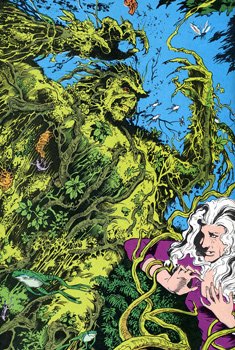
Swamp Thing

Wednesday, June 20, 2012
1963 interviews by Tom Field.

Some of my favourite interviews EVER were with the creators of the 1963 miniseries published by Image comics in 1993. They were conducted by Tom Field and I think they are fascinating reading and really complement the parodic aims of the series. You can read all of the interviews by starting here.
I was lucky enough to ask Mr Field about these fascinating interviews for my PhD research on Alan Moore, and he was kind enough to allow me to share his responses with you below (answers are in bold type):
How were the interviews conducted? These interviews were conducted by phone back in 1993 – with the exception of Alan’s own contributions. It was such work for him to get into the persona of ‘Amiable Al’ that he had to compose his responses on paper and submit them to me via fax.
How much input (if any) into the interviews did the artists on the series have as a whole? A great deal of input. Everyone involved knew what we wanted to do upfront, which was to create a fanzine parody and interview each 1963 creator in character. They all decided upfront what their characters would be like, and they described them to me, so I could ask appropriate questions. I may even have run some of the questions by them in advance. This was pre-email, so we did all our conversations via phone or fax. Steve Bissette, Rick Veitch and Dave Gibbons were particularly funny, and at times our conversations would just devolve into laughter – we cracked ourselves up! The only 1963 creator to politely decline an interview, by the way, was Chester Brown. Guess he was the Ditko of the group. J
How much did Alan Moore provide for the interviews i.e. did he ‘ghost-write’ the artists’ response? No, Alan had no direct input on the artists’ response. He may have helped shape the personalities of the creators in his conversations with Bissette and Veitch, but the artists strictly flew solo in their interviews. Alan’s direct involvement was faxing answers to me in response to my questions to ‘Amiable Al.’
How much input did you have i.e. can I assume that you wrote the introductory material and interviewer sections? Yes, I wrote an introduction to the entire package, as well as intros to each interview. And I tried to take on my own persona as a parody of Roy Thomas. In my mind, I was the young, enthusiastic publisher of an Alter Ego style publication from 1963, and I was sharing my good fortune of meeting all these favorite creators.
The interviews fascinate me as they are such a brilliant parody, which is part of my Phd focus. Here’s the backstory: I was approached by former convention promoter Fred Greenberg, who had just launched a weekly comics newspaper and a monthly comics magazine, and he wanted to devote an entire issue of the mag, Comic Talk, to 1963. He’d gone to the Kubert School with Bissette and Veitch, so he really wanted to help them promote the 1963 project. We decided early on that we didn’t want to do just straight interviews with the creators, but rather we wanted to create a parody mag to extend the 1963 experience. Hence, I interviewed Roarin Rick and Sturdy Steve. The shame is: the magazine was cancelled after I completed my work – there even was a cover drawn for it – and so the package never saw print until Bissette published it online some years ago. Guess it’s fitting in a way because 1963 never quite got finished either. I had a blast on the project, though, and have always wished it might see print with a collection of the series. Hard to believe we’re coming up on the 20th anniversary.
Wednesday, June 6, 2012
Anon E. Mouse by Alan Moore
Here are some really early cartoon strips by Alan Moore. They appeared in Anon #1-5 (The Alternartive Newspaper of Northampton) in 1974-5. They provide a fascinating earlier glimpse of his really early work.


I have posted these under the assumption that Mr Moore seems happy with older works being published online. I'm happy to remove them upon request if this is not the case.
Tuesday, May 15, 2012
'Furballs and Leather' by Leah Fast
Read Furballs and Leather by Leah Fast, an artist who is really making a name for herself. I love this series!
Early Alan Moore work
One of the interesting things about researching Alan Moore are finding odd little things in his work that I've never noticed before.
My research on his early work has drawn out some interesting early examples of ideas he reuses in later work. This episode from 'Roscoe Moscow' (dated November 3rd, 1979) is really interesting:

Look at the opening speech balloon, particularly this line - "They say there's a broken light for every heart on broadway". I knew I'd heard or seen that somewhere before, and then I realised that it's
the opening line in 'This Vicous Cabaret' from V for Vendetta (Warrior #12, August 1983):


Finally, I found that the name of Rocket Redglare, and the concept of the aging hero, were both later reused in a 'Future Shock' story from 2000 AD, 'The Regrettable Ruse of Rocket Redglare' (2000 AD #234, October 1981).
I wonder if I'll find any more similar examples as my research continues?
My research on his early work has drawn out some interesting early examples of ideas he reuses in later work. This episode from 'Roscoe Moscow' (dated November 3rd, 1979) is really interesting:

Look at the opening speech balloon, particularly this line - "They say there's a broken light for every heart on broadway". I knew I'd heard or seen that somewhere before, and then I realised that it's
the opening line in 'This Vicous Cabaret' from V for Vendetta (Warrior #12, August 1983):

The audio version can be heard here
I was also sure I recognised Captain Billy's Bar from somewhere, and I was right. Moore uses the name in his and Don Simpson's In Pictopia (Anything Goes #2, December 1986):

Finally, I found that the name of Rocket Redglare, and the concept of the aging hero, were both later reused in a 'Future Shock' story from 2000 AD, 'The Regrettable Ruse of Rocket Redglare' (2000 AD #234, October 1981).
I wonder if I'll find any more similar examples as my research continues?
Tuesday, February 28, 2012
Monday, November 14, 2011
V for Vendetta

Please excuse the lack of activity since July!
I find it really heartening that Moore and Lloyd's work is the focus of this piece, rather than the film adaptation.
I find it really heartening that Moore and Lloyd's work is the focus of this piece, rather than the film adaptation.
Friday, July 15, 2011
Hit me!
I've been listening to this song lots and lots recently. I've never embedded a video into a blog before, so I thought I'd try it here:
A-ha! Success! Play it and enjoy!
Dredd & Douglas Wolk
Douglas Wolk is a critical god as far as I'm concerned. His book, Reading Comics, should be read by anyone with a passing interest in really good arts criticism, as well as those wanted to read up about comics. His new blog project, Dredd Reckoning, is well worth checking out. He is exploring every Judge Dredd story in chronological order.
I don't remember much about the first Judge Dredd story I read, but it would have been the one in this issue:
 This was the strangest comic cover I'd ever seen! I was eight, and it blew my mind!
I don't remember much about the first Judge Dredd story I read, but it would have been the one in this issue:
 This was the strangest comic cover I'd ever seen! I was eight, and it blew my mind!
Welcome
Welcome to my new blog.
As much as I enjoyed blogging at Mad about Comics, I wanted to spread my wings further by writing about, and linking to, a wider range of topics than just comics. As such, I'll be writing about anything and everything here. I imagine this will include anything from comics, TV programmes, books, music, films, education, study skills, libraries, independent scholarship and more.
As much as I enjoyed blogging at Mad about Comics, I wanted to spread my wings further by writing about, and linking to, a wider range of topics than just comics. As such, I'll be writing about anything and everything here. I imagine this will include anything from comics, TV programmes, books, music, films, education, study skills, libraries, independent scholarship and more.
An ending, and a new beginning
I'm retiring this blog. This isn't because I've lost interest in comics (I haven't, and I hope I never will), but I want the opportunity to write about, and post links to, a wider range of subjects in addition to comics. I hope you'll join me here.
Subscribe to:
Posts (Atom)